Human Fusions institute
Creating human-technology relationships for a thriving, just, and connected society
Partners
Human Fusions
Building NeuroRealityTM to connect humans with technology over long distances in real time.
Headquarters
Case Western Reserve University

Dr. Veronica Santos and her team at the University of California, Los Angeles are amongst the foremost scientists in the development of human-in-the-loop robotic systems that incorporate multi-modal tactile sensors for grasp and manipulation.
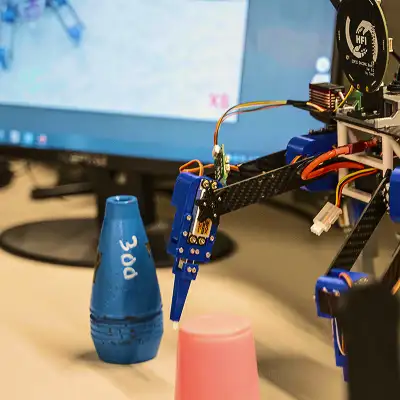
Dr. Santos and her team are leading the development of the mechatronic systems for NeuroRealityTM and the embedded human experience.

Dr. Nicholas Zingale at Cleveland State University is an expert in phenomenology, or the study of the development of the human consciousness and self-awareness. He is also an expert in urban development and making sure technology is available for all.
Dr. Zingale and his team are leading the efforts to understand how we experience ourselves, others, and our world through an embodied, NeuroReality experience, as well as the ethics and implications of Human Fusions.

Dr. Douglas Weber at Carnegie Mellon University is an expert in neural engineering and neuroscience. He leads research to understand the neural signals' relationship to perception of one's self and the world around us.
Dr. Weber and his team are leading the cognitive neuroscience research to understand how external, technical sensors converted to neural signals and then integrated into human perception to understand the world through the embedded link.

Dr. Justin Piccorelli at the University of Wyoming is a trained phenomenologist who examines how we know, and what it means in practice. He performs research with the Human Fusions Institute and University of Wyoming’s 3D Visualization Center to understand the epistemic impact of NeuroReality, explore the therapeutic potential of applied technological tools, and build technologies centered on human values. Dr. Piccorelli is leading the discussion and consideration of the ethical and epistemic impact of NeuroReality and the new human-technology paradigm.

Dr. David Hodge at Tuskegee University is an expert on the challenges, opportunities, and understanding of ensuring that everyone is equally and fairly able to fully participate in society and the scientific and technological advances shaping society.
Dr. Hodge will lead the Human Fusions institute in developing NeuroReality in a just manner to ensure everyone is able to partake in the thriving and connected world NeuroReality seeks to enable.
UCLA
Cleveland State Univ
Carnegie Mellon Univ
Univ of Wyoming
Tuskegee Univ
Global leader in NeuroRealityTM
is building multi-institutional consortium

Since 1962, Case Western Reserve University has been a world leader in the integration of humans and technology for human health, and specifically, for neural engineering and rehabilitation engineering.
In early 2010's, Dr. Tyler, and expert in neural interfaces and neural engineering, began applying this technology at the Cleveland VA Medical Center to restore sensation to and connect individuals with limb loss directly to their prosthesis. This lead to a profound emotional and functional benefit where the prosthesis, "felt like their hand."
Human Fusions and NeuroRealityTM were born from the realization that the prosthesis is equivalent to a robotic system and it does not need to be attached to a persons arm to feel like their hand. By expanding these advances to any human-technology relationship, the Human Fusions Institute is advancing the new paradigm of the human-technology relationship were humans don't use technology, they EBMODY technology to combine the best of the human with the best of the technology.

Partners within Case Western Reserve
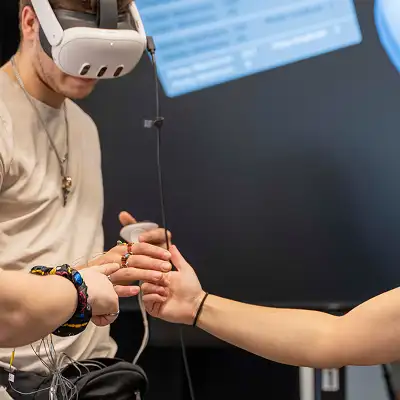
NeuroRealityTM enables us to be physically in one place and experientially in another
By directly connecting the human experience to the Avatar's experience, the human and the robotic system become symbiotically linked. The human experiences the world of the robot. The robot becomes the extension of the human and the human intelligence.